Perhaps the most frustrating aspect of learning guitar is that it initially seems impossible to play anything that actually sounds good. While it is true that it takes some time to learn the techniques needed to play songs well, the real reason most new guitarists sound bad is because their instrument isn't in tune. Here is a guitar tuning tutorial that, with a little practice, should allow you to keep your instrument in tune.
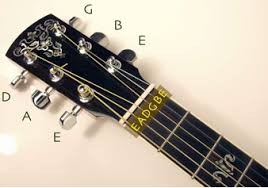
Note that there are two E strings on a standard six-string guitar. The thickest string is the bottom E (or low E) and the thinnest string is the top E (or high E). Low E is the top string.

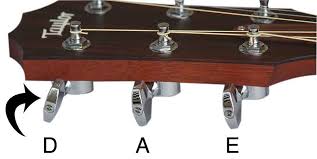
Follow each string up to its tuning key and make note of how they correspond and which way you should turn them to make the strings tighter or looser. (Tightening will make the pitch higher, while loosening the string will make the pitch lower.)







How Often Should I Tune my Guitar?
You should tune your guitar every single time you pick it up. Guitars (particularly cheaper ones) tend to go out of tune quickly. Make sure your guitar is in tune when you begin to play it, and check the tuning frequently while you're practicing, as the act of playing the guitar can cause it to go out of tune.
How Long Does Tuning the Guitar Take?
At first, it may take you five minutes or more to get your guitar in tune, but the more familiar you are with tuning, the more quickly you'll be able to do it. Many guitarists can get their instrument roughly in tune in about 30 seconds.
Let's move on to learning the process of tuning the instrument.
1)Know which note each string on the guitar plays.
Note that there are two E strings on a standard six-string guitar. The thickest string is the bottom E (or low E) and the thinnest string is the top E (or high E). Low E is the top string.

2)Know which tuning keys correspond with which strings.
Follow each string up to its tuning key and make note of how they correspond and which way you should turn them to make the strings tighter or looser. (Tightening will make the pitch higher, while loosening the string will make the pitch lower.)
3)Tune the bottom-E string.
This is the string you will use as a reference by which you can tune the rest of the guitar. (It’s good for this purpose because its thickness makes it less likely to detune.) Before you can do that, however, you must get it properly tuned.

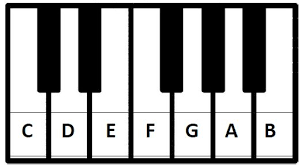
Find a way to listen to an E note. This can be done using a (properly tuned) piano, a pitch pipe, a tuning fork, or a recorded E note.You can also play it from a piano/keyboard and compare.
Pluck the bottom-E string while listening to the E note from the other sound source.
Turn the tuning key for the bottom-E string until your guitar's bottom-E string sounds the same as the known E note. When the string is slightly out of tune, the E from the guitar will combine with the E from the sound source (i.e. piano), and cause the sound to "waver" in pitch. This is dissonance. As you tighten the guitar string, you should hear this wavering slow down; the two strings are in tune if the wavering has stopped. If you go too far, the wavering will increase again.
4)Tune the A string.
Now that the E string has correctly been tuned, you can use it to tune the next string over.
Push down on the fifth fret of the bottom-E string that you just tuned and pluck the string. The resulting note is A (which is what you want the next string over to be) and can be used as your new reference point for pitch. This will be referred to as the fifth-fretted bottom-E string.
Pluck the A string and compare it to the sound of the fifth-fretted bottom-E string. Pluck the two strings in succession and then simultaneously.If the sound produced when both of them are plucked together is a uniform sound with a same pitch, you have tuned it perfectly! Else adjust the tuning screws until you do not hear multiple sounds.
Turn the tuning key for the A string until it sounds the same as the fifth-fretted bottom-E string.
5)Tune the D string.
Now the fifth fret in the A-string will be your reference to tune the D string.
Pluck the D string and compare it to the sound of the fifth-fretted A string. Pluck the two strings in succession and then simultaneously.
Tune the D string to the fifth-fretted A string.
6)Tuning the G string.
Pluck the G string and compare it to the sound of the fifth-fretted D string. Pluck the two strings in succession and then simultaneously.

Tune the G string to the fifth-fretted D string.
7)Tune the B string.
Pluck the B string and compare it to the sound of the fourth-fretted G string. Pluck the two strings in succession and then simultaneously.
Tune the B string to the fourth-fretted G string. Note that this is the only time the fourth fret is used.

8)Tune the high-E string.
Pluck the top E string and compare it to the sound of the fifth-fretted B string. Pluck the two strings in succession and then simultaneously.
Tune the top E string to the fifth-fretted B string. Be very careful when tightening this string as it can break easily.
Thank you for reading this!


